

8/31/26 RENO, Nev. (KOLO):
By Noah Bond
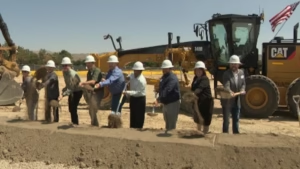
Officials with the City of Reno, City of Sparks, Washoe County and Truckee Meadows Water Authority take part in a groundbreaking ceremony for Nevada’s first Advanced Purified Water Facility on Monday, Aug. 31, 2026, at 11100 Lear Blvd. in Reno.(Luis Latino | KOLO)
RENO, Nev. (KOLO) — The City of Reno and the Truckee Meadows Water Authority broke ground Monday on Nevada’s first Advanced Purified Water Facility.
The groundbreaking ceremony was held at 1 p.m. at 11100 Lear Blvd. Local and state dignitaries attended and gave remarks.
The project has received millions in grants for construction costs, according to Lydia Teel of the Truckee Meadows Water Authority.
“So we’ve received over $39 million in grants, and so we’re really focused on for construction costs,” Teel said. “Rates for customers will not go up for TMWA customers on this. So, again, like we have sustainability and everything built into our current rates, but for this facility, construction costs will not increase TMWA customers.”
Project decades in the making
Paul Anderson, a Sparks City Council member for Ward 3 and chairman of the board for both the Truckee Meadows Water Authority and the Western Regional Water Commission, said the project has been in development for a very long time.
“This is something that’s been in the making for decades,” Anderson said. “And what it is, is it’s making our region more sustainable for water.”
Anderson said the project involves water reuse, specifically potable reuse, for residents and businesses in the North Valleys area. He said it is the first project of its kind approved in Nevada.
“This project’s even bigger than that,” Anderson said. “It’s actually going to benefit the entire state of Nevada, because this is the first project in the state that’s ever been approved.”
Anderson said the process took years to reach groundbreaking because of permitting requirements at the federal, state and local levels, along with securing funding and coordinating agencies.
“You’ve got everything from permitting, so you need federal, state, regulators to look at it and approve it,” Anderson said. “And then it has to move all the way through the process to even local governance to make sure. Then you’ve got the funding portion. And then once you get the funding, then you need collaboration of all the different agencies.”
Anderson said the City of Sparks, City of Reno, Washoe County and the Truckee Meadows Water Authority all worked together on the project.
Collaboration cited as key to project’s progress
Anderson said collaboration among agencies has been central to the project’s success, noting similar projects elsewhere in the country have faced more difficulty.
“A lot of projects like this are happening around the country,” Anderson said. “But they’re not having as much success as we are because of the collaboration. It doesn’t matter if it’s the University of Nevada, Reno, or the City of Reno, Truckee Meadows Water Authority. They’re all working together to make this project happen.”
Anderson said the facility will provide a water source regardless of drought conditions.
“What’s so exciting about this is just that it truly is going to help us, whether we’re in a drought or out of drought,” Anderson said. “We’re always going to have water that we’ll be able to provide to the community through projects like this.”
Anderson compared the treatment process to a water filter, though more advanced, and said the region worked with the Water Innovation Institute at the University of Nevada, Reno, to develop new technology because the facility is not located near an ocean, where similar projects typically discharge brine byproduct.
“What’s exciting about this project, it is kind of like a Brita filter, but far more technological than that,” Anderson said. “We aren’t near an ocean here, so we had to come up with a new technology. We have people from around the world looking at what we’re doing here and applying it to their projects across the country and the world.”
City cites wastewater solution, flood and drought benefits
Trina Magoon, director of Utility Services at the City of Reno, said the project addresses an effluent management need for the city’s recently expanded wastewater treatment plant.
“For the City of Reno, we needed an effluent management solution for our recently expanded wastewater treatment plant,” Magoon said. “We looked at a number of alternatives, but this one really rose to the top as being a wonderful collaboration with the Truckee Meadows Water Authority, all of our funding partners, and really being able to reuse a vital resource here in northern Nevada. So it’s just a win-win-win all the way around.”
Magoon credited staff and elected officials who worked on the project before her.
“I would say the feeling is just fantastic,” Magoon said. “But I really want to thank the people who were before me. A lot of staff and a lot of elected officials and a lot of people really have been working on this project for decades.”
Magoon said the project allows Reno to divert effluent previously sent to Swan Lake.
“This isn’t just important for drought,” Magoon said. “We were sending some of our effluent to Swan Lake and we can now divert that effluent. So it helps us from a flooding standpoint and a drought standpoint. Not often you get to say both of those at the same time.”
Magoon said the next step is pursuing indirect potable reuse to prepare for future direct potable reuse needs at the Truckee Meadows plant.
“I guess I would say the next real opportunity for this is proving up indirect potable reuse for future needs of direct potable reuse in the future,” Magoon said. “And we’ll likely need that at our Truckee Meadows plant.”
Background from City of Reno Vice Mayor
Reno City Council Member and Vice Mayor Miguel Martinez also spoke at the event, in Spanish. According to a translation of his remarks, Martinez said the project has been about 20 years in development and involves collaboration with local and state governments and the University of Nevada, Reno, including professors and engineers who conducted research for the project.
Martinez said the water produced will meet the standards required by the city and federal agencies to be considered potable. He said the loan for the project was obtained jointly by the City of Reno and the Truckee Meadows Water Authority, and that project costs will be recovered through the future sale of water and water rights produced by the project.
Martinez said the water is intended for potable use in homes and residences, particularly in the growing North Valleys area, and would supplement current water resources drawn from the Truckee River and Lake Tahoe.